General Terms for how to Solve a Rubik's Cube.
Introduction
This page introduces the fundamental terminology and notation used in Rubik's Cube solving. Understanding these terms is essential to follow tutorials and improve your solving speed.
Basic Notation
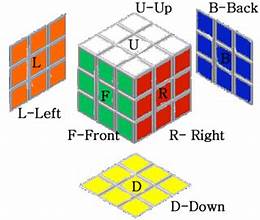
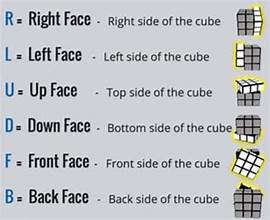
Rubik's Cube moves are denoted using letters representing the six faces of the cube with your view as the refrence point (how you are holding the cube):
- R – Right face
- L – Left face
- U – Upper face
- D – Down face
- F – Front face
- B – Back face
Move Types
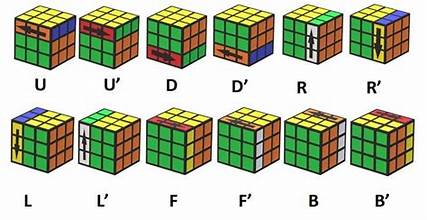
Each move can be performed in three ways:
- Standard (Clockwise) – 90-degree clockwise turn of the face (R).
- Prime (Counter-Clockwise) – Denoted by an apostrophe, e.g., R', rotates 90 degrees counter-clockwise.
- Double Turn – Denoted by the number 2, e.g., R2, rotates 180 degrees.
Cube Pieces
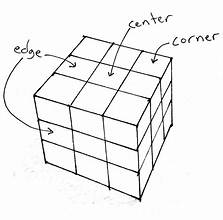
The Rubik's Cube has three types of pieces that make up the cube:
- Center Pieces – Fixed in place, define the color of each face.
- Edge Pieces – Two-colored pieces that connect centers.
- Corner Pieces – Three-colored pieces at the corners of the cube.
Algorithms
Algorithms are sequences of moves designed to move certain pieces without disturbing others. Example of a simple algorithm: R U R' U'. These sequences are the building blocks for solving the cube step by step.
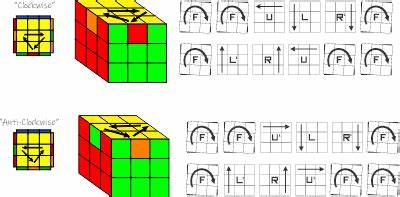
This terms page is intended for beginners. Each section can be expanded with additional images, GIFs, or interactive diagrams to make learning more visual. Additionally, please see the How to Solve A Cube page for more infomation.